Overview
Audience: New employees at a specific company
Responsibilities: Project management, action mapping, learning design, development, script writing, web-design
Tools Used:
- Articulate Storyline
- Articulate Rise
- SharePoint
- Canva
- Adobe Premiere Pro
- Vyond
- WellSaid
- Draw.io
- Atlassian Confluence
“Talking at learners through PowerPoints on a Zoom call are history.”
— Happy Stakeholder
Problem and solution
Traditional new hire orientation programs are characterized by excessive meetings, placing a significant burden on training specialists and resulting in a lackluster experience for new employees. The process has been historically labor-intensive, time-consuming, and fails to engage new hires effectively. Employees often find themselves in a passive role, merely observing and listening, leading to a diminished sense of empowerment and involvement in their own onboarding.
The New Hire Orientation Transformation project seeks to revolutionize the onboarding experience by shifting the focus from a company-centric approach to one that places the learner at the heart of the process. The solution is designed to empower new employees, encouraging them to actively participate in their onboarding journey rather than passively absorbing information. By adopting interactive and learner-centric strategies, the project aims to create a more engaging and personalized orientation experience. Through this transformation, the goal is to enhance employee satisfaction, boost retention, and ultimately contribute to a more effective onboarding process that aligns with the dynamic needs of both the organization and its newest team members.
Process
Action Mapping
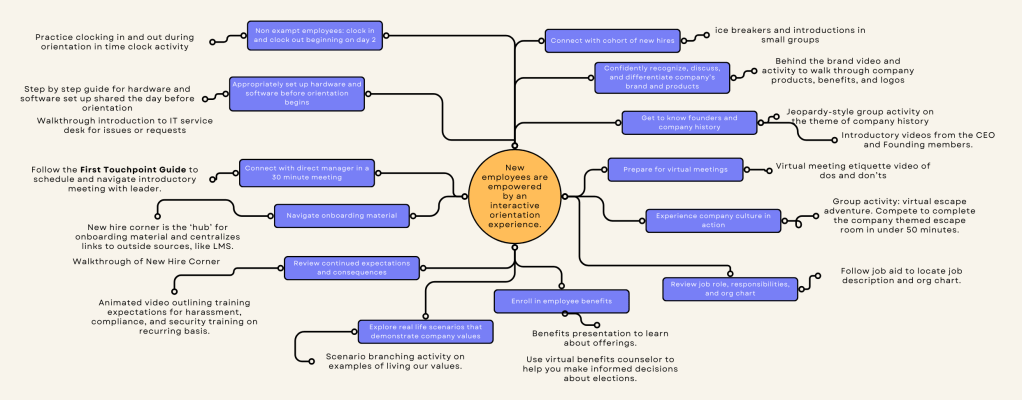
The action map was created in collaboration with the New Hire Experience lead and the Director of People Operations who work heavily with new employees.
Visual Mockups & Gaining interest
This project involved multiple designers and required input and feedback from multiple parties. To generate interest in the project, I developed an Orientation Trailer as a sneak peek to the project for relevant teams.
Full Development
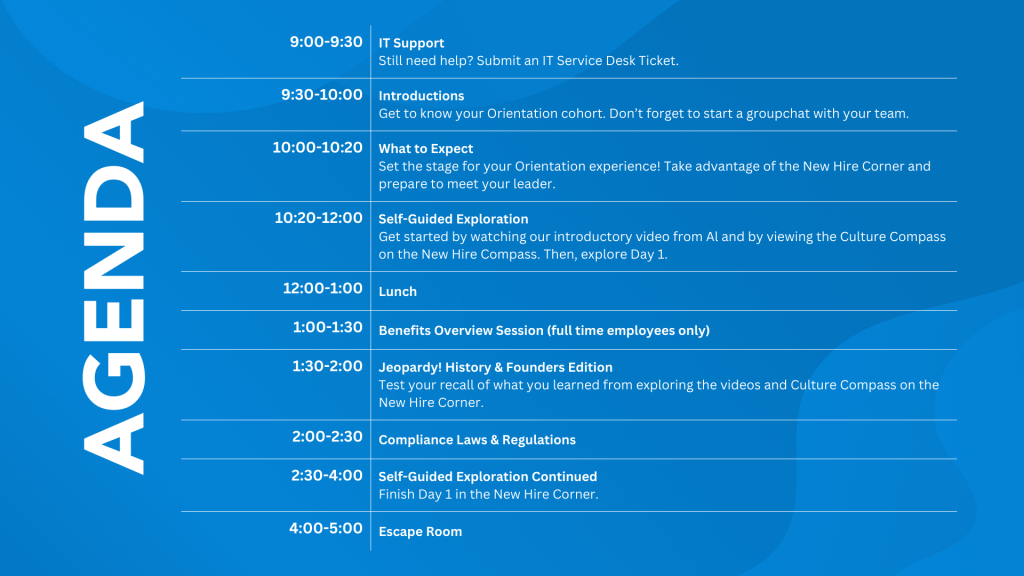
After defining the performance objectives, developing visual mockups, and meeting with peer designers, we collaborated to complete 25 stories over the course of 6 sprints to complete the full transformation of orientation. Development included Articulate Storyline and Rise, Powerpoint for VILT, Vyond Animation, Canva, and Confluence.
Favorite Features
New Hire Corner: Hub for new employees to easily access all of the material available during their first week at the company. The site is centrally located in SharePoint page that can be accessed via company credentials
Easy to follow checklists: Simple check-lists keep new employees on track throughout their first and second days at the company.
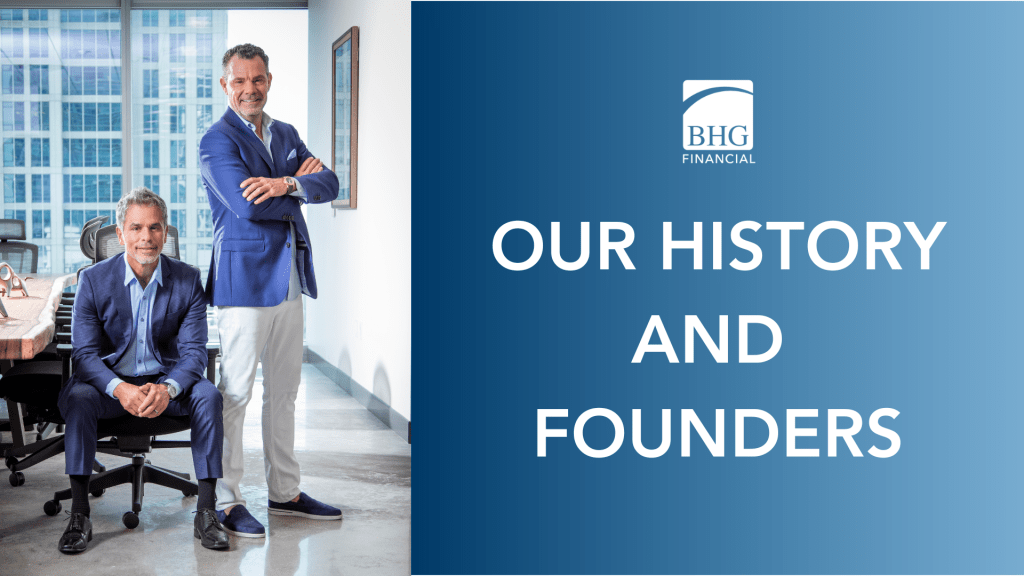
Diverse facilitator involvement: The new orientation format requires less information-dense facilitation, opening the floor for facilitators from all areas of the company to become involved. Providing our new employees with a diverse look at various departments through representation in the orientation experience is a brand new experience compared to the previous facilitation group which consisted only of learning & development professionals.
Cohort Teams Channel: A teams channel designated for each cohort of new employees helps build connections that can be powerful throughout their tenure at the company. This chat allows new employees not only to communicate with each other, but also for the new hire experience team to quickly and conveniently deliver critical reminders and updates.
Gamification: Orientation can be long and draining with dense videos and documents, so the new hire experience transformation is meant to disrupt the minutia by including a variety of gamified experiences. We chose to introduce interactive activities to all information surrounding culture, employee perks, and what makes the company standout. This includes a scavenger hunt for employee perks and experiences, a Jeopardy-style game about company history, and a culture-based virtual escape room!
Group activities: This experience emphasizes the importance of relationship building early on in an employee’s tenure. Early in the day, ice-breakers are done in small groups to take the pressure off. These groups will be continued throughout the day for additional activities including Jeopardy and a virtual escape room, both of which offer prizes for the winning teams.
Flexible options for small orientation classes: Fluctuations in orientation class sizes require flexibility for the new hire experience team that delivers the experience. A flexible version eliminates group activities so the entire cohort can function as one cohesive team.

Takeaways
Results and impact
Following the completion of the project, we onboarded 15 new facilitators, while decreasing the onboarding time required for the new hire experience team.
New employees have reported higher levels of excitement for their new role.
We have noticed a heavy decrease in questions around post-orientation processes. This could be related to the centrally-located new hire documentation found in the new hire corner, or due to higher engagement in the activities explaining the processes.
The journey to transform new hire orientation has instilled a culture of continuous improvement within our team. Recognizing that excellence is an ongoing pursuit, we are committed to embracing a mindset that welcomes change and innovation. Future iterations of the orientation program will be informed by this commitment to constant enhancement.
Reflections and future improvements
Scalability and flexibility: One area of the project where we exceled, was preparing for changes and inconsistency between cohorts. Some groups may have 2-3 employees, while others can be cohort sizes of up to 40 of diverse positions. By creating virtual experiences that can be completed live in groups, or individually, the orientation team is better equipped to easily make modifications.
Facilitator involvement: We chose to involve a brand new set of facilitators in this project. It was essential for us to create an in-depth facilitator guide and host facilitator info sessions to prepare them to deliver orientation material.
Measuring impact: The key performance indicators provided valuable insights into the success of the transformation. However, there is a need for ongoing evaluation and potential adjustments to align with organizational goals and evolving industry standards. Flexibility in adapting measurement sources will be crucial for staying responsive to the changes within the company.
Balancing personalization and scalability: Achieving the right balance between personalization and scalability was a noteworthy consideration. While the program succeeded in providing a more personalized experience, we acknowledge the need for continued exploration of technologies and strategies to maintain this personal touch as our organization grows.
 Briana Gattis
Leave a comment